
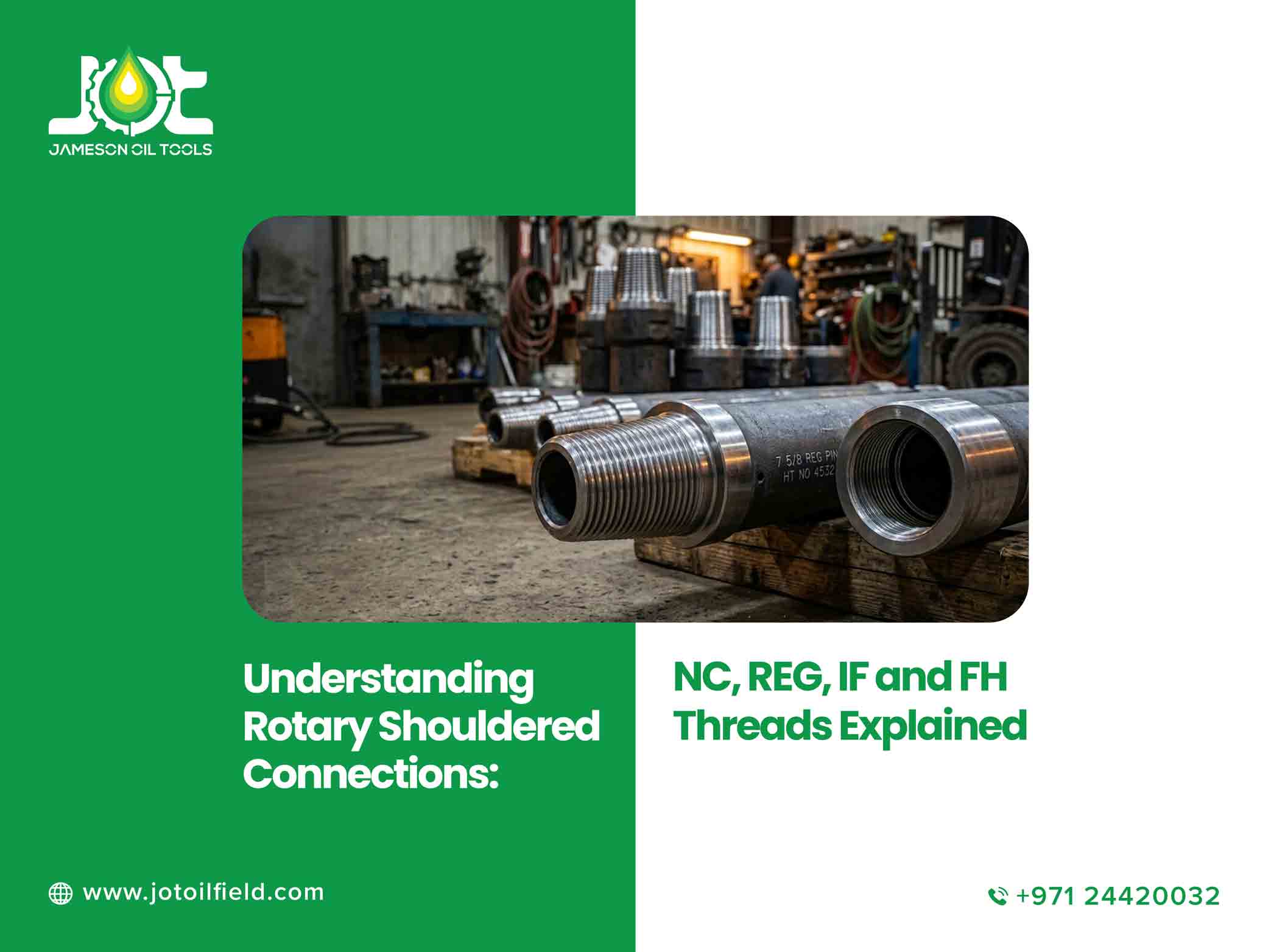
In every drilling operation, the drill string is made up of many components joined together: drill pipe, drill collars, stabilizers, mills, and crossover subs. These parts are connected using rotary shouldered connections. These threaded connections must transmit torque, carry heavy loads, and hold pressure, all while being made up and broken out hundreds of times.
Choosing and inspecting the right connection is essential for safe and reliable drilling. In this blog, JOT Oilfield Services, a trusted oil & gas equipment supply & service company, explains what rotary shouldered connections are and the differences between NC, REG, IF, and FH thread types.
A rotary shouldered connection is a threaded joint used to connect drill string components. It has two parts:
When made up, the two shoulders of the connection press tightly together. This shoulder - not the threads alone - carries the load and seals the connection. This is why they are called "shouldered" connections.
These connections are designed to:
Using the correct connection ensures:
A wrong or worn connection can lead to fatigue cracks, washouts, and costly fishing operations. This is why oilfield equipment manufacturers follow API standards for all connection types.
There are several families of rotary shouldered connections. Each was developed for specific performance needs.
The NC connection is the most widely used type in modern drilling.
NC connections are popular because they are reliable, standardized, and interchangeable across suppliers.
The REG (Regular) connection is one of the oldest connection types still in use.
REG connections are often found where tools connect to bits and milling assemblies.
The IF (Internal Flush) connection is designed for better flow.
IF connections are chosen when maintaining flow efficiency is important.
The FH (Full Hole) connection also focuses on flow performance.
FH connections are a practical choice where both flow and strength are needed.
|
Connection Type |
Key Feature |
Common Use |
|
NC (Numbered Connection) |
Balanced strength and torque |
Drill pipe, collars, downhole tools |
|
REG (Regular) |
High-torque reliability |
Bits, mills, stabilizers, subs |
|
IF (Internal Flush) |
Larger bore, better flow |
High flow rate drilling |
|
FH (Full Hole) |
Good flow and strength |
Drill pipe and tools |
No matter the connection type, thread quality must be verified. Repeated use causes wear, galling, and fatigue that can lead to failure.
Proper thread inspection includes:
At JOT, every connection is inspected and gauged to ensure it meets API requirements before the tool leaves the facility.
As a trusted Oil & Gas Equipment Supply & Service Company, JOT Oilfield Services provides:
We supply operators across the UAE, Oman, and Saudi Arabia with tools built and inspected to industry standards.
Rotary shouldered connections are the backbone of every drill string. NC, REG, IF, and FH connections each offer different strengths - from balanced performance to improved flow. Understanding these connection types helps operators select the right tools and avoid costly failures.
At JOT Oilfield Services, precision machining, expert thread inspection, and reliable reconditioning ensure every connection performs safely in demanding drilling operations.
Browse our comprehensive catalogue for a diverse range of high-quality oil and gas equipment solutions.