Pilot Mills vs Watermelon Mills vs Taper Mills: Understanding the Differences



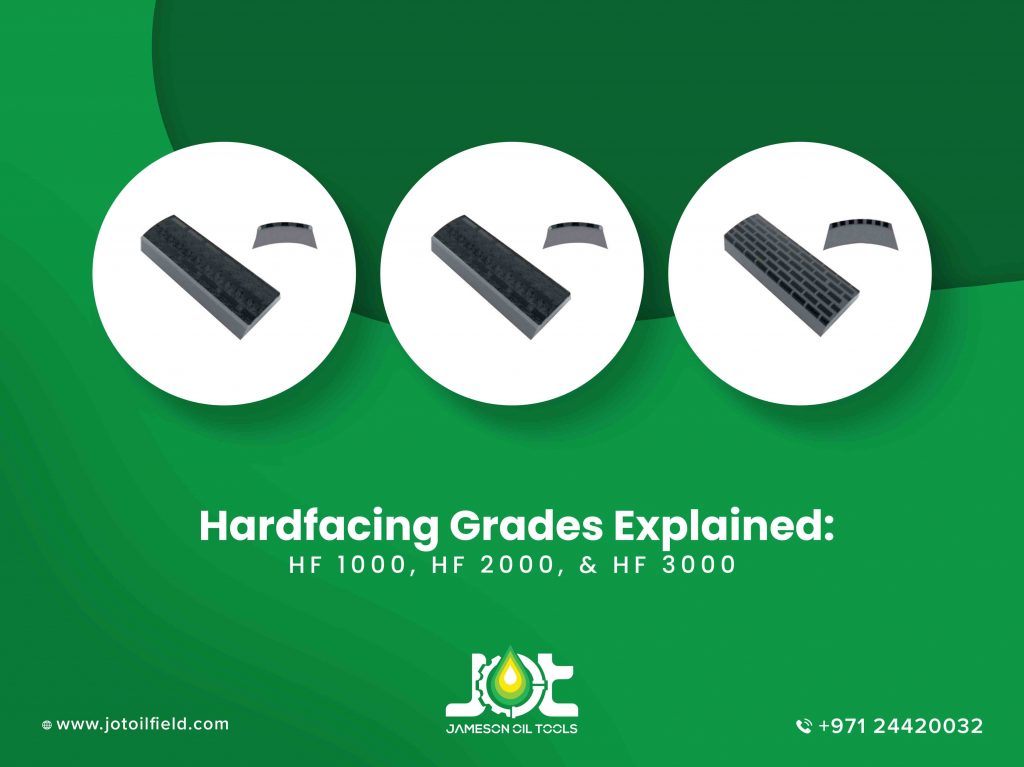
Hardfacing protects drilling tools from abrasive wear, extending run life and reducing replacement costs. JOT Oilfield Services offers three specialized grades- HF 1000, HF 2000, and HF 3000- each optimized for specific formation types and operational conditions.
Choosing the right Hardfacing Grades matches tool protection to your drilling environment, maximizing performance across soft, medium, and hard formations.
Designed for: Less abrasive environments
Composition: Crushed tungsten carbide in nickel matrix
Key Features: Cost-effective protection, excellent bonding to base material
Ideal Applications:
Performance: Reliable protection for formations where extreme abrasion resistance isn’t critical.
Designed for: Transitional formations
Composition: Cast tungsten carbide inserts with powder metal matrix
Key Features: Balanced abrasion/impact resistance
Ideal Applications:
Performance: Superior wear resistance with good impact tolerance for variable conditions.
Designed for: Maximum abrasion resistance
Composition: Premium tungsten carbide tiles with advanced powder spray deposit
Key Features: 97% ultrasonic bonding guarantee, highest carbide density
Ideal Applications:
Performance: Longest life in the most abrasive conditions.
Formation-Based Selection:
Soft formations (sandstone, shale): HF 1000
Medium formations (limestone, dolomite): HF 2000
Hard formations (chert, hard limestone): HF 3000
Tool-Specific Applications:
Stabilizers: HF 2000/3000 (high contact areas)
Motor sleeves: HF 1000/2000 (moderate wear)
Milling tools: HF 3000 (extreme abrasion)
1. Surface Preparation
Complete weld removal, surface profiling, pre-heat treatment
2. Precision Application
Automated carbide placement, controlled matrix deposition, multi-layer build-up
3. Quality Assurance
Inspection Schedule:
Visual check every run
Dimensional inspection every 3-5 runs
Reapplication when 50% carbide coverage lost
Proactive Strategy:
Step-down maintenance (HF 3000 → HF 2000)
Regular inspections prevent emergency repairs
HF 1000: Lowest cost, good performance in soft formations
HF 2000: Balanced cost/performance for most applications
HF 3000: Higher upfront cost, lowest cost per run in hard formations
Typical Benefit: 3-5x run life extension vs. unprotected tools
Hardfacing Grades such as HF 1000, HF 2000, and HF 3000 provide targeted protection for every drilling environment. Proper grade selection optimizes tool life, reduces NPT, and improves project economics..
JOT Oilfield Services applies all three grades with precision and certification, ensuring maximum performance in UAE, Oman, and Saudi Arabia formations.
Need hardfacing for your next run? Contact JOT today to select the optimal grade for your operation.




Browse our comprehensive catalogue for a diverse range of high-quality oil and gas equipment solutions.