JOT Oilfield Services LLC

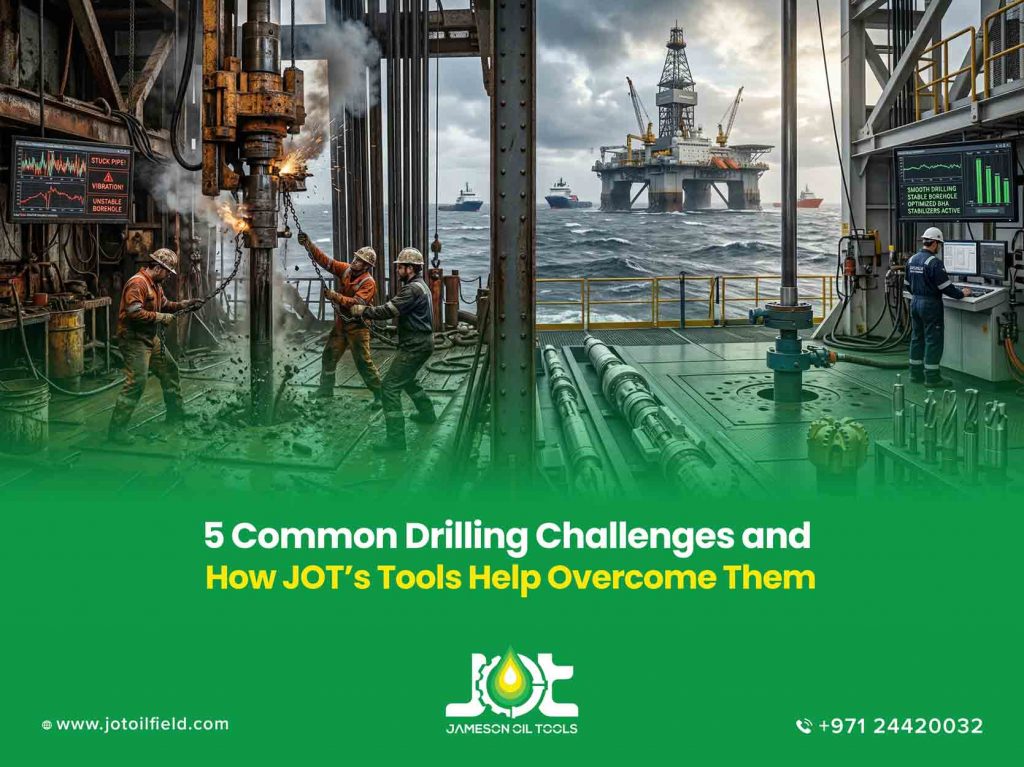
5 Common Drilling Challenges and How JOT’s Tools Help Overcome Them

  • March 13, 2026
5 Common Drilling Challenges and How JOT’s Tools Help Overcome Them

Drilling a well is never just “drill ahead.” Operators constantly battle issues like hole deviation, stuck pipe, borehole instability, and poor hole cleaning, all of which can add major non-productive time if not controlled. Industry studies consistently list problems such as hole deviation, pipe failure, borehole instability, lost circulation, pipe sticking, and mud-related issues among the most frequent challenges encountered while drilling.

JOT Oilfield Services designs and manufactures downhole tools specifically to help reduce these risks and keep your operation moving efficiently.

1. Hole Deviation and Poor Trajectory Control

Unplanned deviation can lead to doglegs, keyseats, higher torque and drag, and difficulty running casing later in the well’s life. Directional wells are even more sensitive, poor stabilization or BHA design quickly shows up as toolface control issues and inconsistent steering.

How JOT helps:

  • Integral and non-magnetic stabilizers are engineered with optimized blade profiles and spacing to centralize the BHA and maintain planned inclination and azimuth.
  • Window mills and pilot mills are designed to start and maintain clean casing exits and sidetracks, helping directional drillers build and turn predictably.
  • Precision machining and tight dimensional control at JOT ensure gauge accuracy, so stabilizers actually deliver the trajectory control they were designed for.

2. Stuck Pipe and Poor Hole Cleaning

Stuck pipe, whether differential, mechanical, or related to poor hole cleaning, is consistently identified as one of the most expensive complications in drilling operations. Accumulated cuttings, high doglegs, and ledges all increase the risk of the drill string becoming immobilized.

How JOT helps:

  • Stabilizers with smooth, properly hardfaced blades help maintain a uniform hole and reduce ledge creation or aggressive keyseating that can trap collars and tool joints.
  • Milling tools such as Economills and pilot mills are designed to dress off ledges, cement, and obstructions, restoring drift and helping free stuck assemblies during recovery operations.
  • JOT’s attention to surface finish and blade geometry minimizes cuttings hang up around tools, supporting better hole cleaning when combined with proper hydraulics.

3. Excessive Vibration, Torque, and Drag

Downhole vibration and high torque and drag contribute to premature tool failure, poor rate of penetration, and difficulty sliding or rotating through deviated intervals. Poorly placed or poorly profiled stabilizers are a known cause of these problems.

How JOT helps:

  • Balanced stabilizer designs with optimized blade count and spiral profiles help smooth out BHA dynamics, reducing lateral vibration and torque spikes.
  • Hardfaced gauge protection (HF 1000, HF 2000, HF 3000) maintains blade shape over multiple runs, so the stabilization behavior of the BHA stays predictable instead of degrading from wear.
  • Crossover subs and precision connections allow operators to assemble the ideal BHA configuration without improvising thread engagement or spacing that might worsen torque and drag.

4. Rapid Tool Wear in Abrasive Formations

In abrasive or hard formations, stabilizers, sleeves, and mills can lose gauge quickly, leading to poor hole quality, loss of directional control, and more frequent trips to change tools. Once gauge is lost, hole cleaning and casing running also become more difficult.

How JOT helps:

  • JOT applies application specific hardfacing grades (HF 1000 for softer formations, HF 2000 for medium formations, HF 3000 for medium to hard and abrasive formations) to stabilizers, sleeves, and mills to dramatically increase wear life.
  • Refurbishment and re hardfacing services restore worn tools to near original dimensions, allowing operators to reuse high value bodies instead of constantly purchasing new tools.
  • Consistent hardfacing quality and ultrasonic bonding checks at JOT help ensure carbides stay in place in high impact, high RPM environments.

5. Tool Compatibility and Assembly Complexity

Modern drilling programs frequently combine equipment from multiple manufacturers, with different connection types, diameters, and lengths. Poorly planned transitions and improvised subs can create mechanical weak points, connection failures, or BHAs that don’t behave as modeled.

How JOT helps:

  • Crossover subs (X over tools) from JOT are manufactured to API 7 1 with precise pin and box combinations, allowing safe, reliable connection between different drill pipe, collars, motors, MWD tools, and specialty equipment.
  • By standardizing on properly engineered crossovers, operators can reduce the number of improvised or field machined adapters, improving drill string integrity and simplifying inventory.
  • JOT’s engineering support helps customers design BHAs that use the minimum number of transitions needed, improving stiffness, reducing stress concentrations, and supporting smoother drilling.

Why the Right Tools Matter

Common drilling challenges like deviation, stuck pipe, vibration, rapid wear, and compatibility issues are well known across the industry, but their impact depends heavily on the quality of the tools in the string and how they are applied. JOT Oilfield Services focuses on precision manufacturing, robust hardfacing, and practical BHA solutions so that operators in the UAE, Oman, and Saudi Arabia can address these challenges proactively rather than reactively.

By choosing purpose built stabilizers, mills, hardfaced tools, and crossover subs and maintaining them through inspection and refurbishment, clients can reduce non productive time, extend asset life, and keep their drilling programs on schedule. 

Download Catalogue

Browse our comprehensive catalogue for a diverse range of high-quality oil and gas equipment solutions.

Download
Top